

BEWDLEY is one of the latest towns to host a screening of the People’s Emergency Briefing film, joining more than 1,000 others towns and community groups.
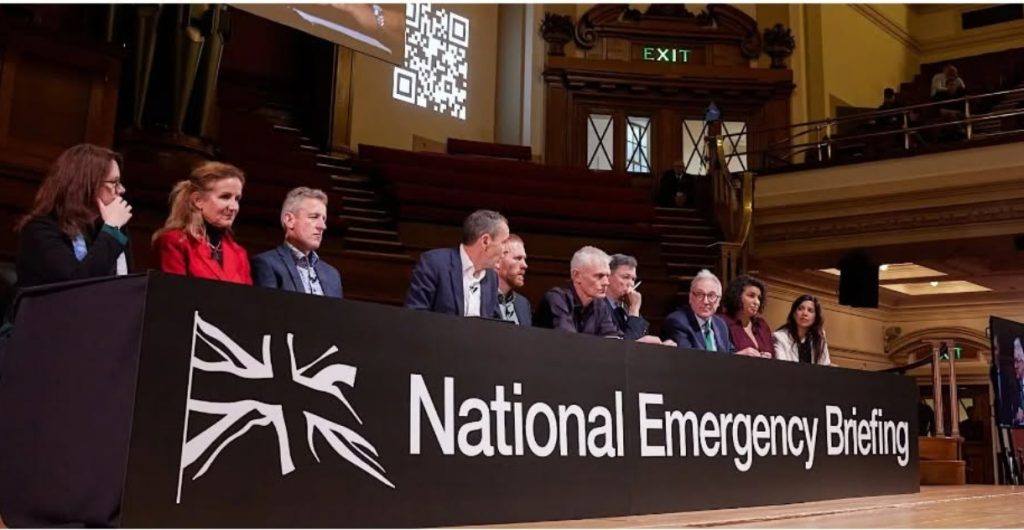
In November 2025, Westminster Hall hosted a gathering of 1,200 politicians and leaders under the title of the ‘National Emergency Briefing’.
Ten experts presented the threats and solutions associated with climate change and nature loss.
A short film version is now being rolled out across the UK, including an event on Friday, June 19, at St George’s Hall, Bewdley.
The 50-minute film, being shown as part of the Wyre Forest Sustainability Festival (SustFest), is free to view, starts at 7.30pm and will be followed by a short discussion.
The experts inevitably covered the impact of weather extremes and weather ‘tipping points’ on climate and nature but also highlighted increased risks to the economy, health and food security.
Former British Army officer, Lt Gen Richard Nugee told how the Ministry of Defence is recognising that climate change is a threat to national security.
He said: “What concerns me most is not any single crisis. It is crises cascading together – food, health, infrastructure, migration, energy, extreme weather – all hitting at the same time, eroding trust in government by slow or failed responses.
“The biggest concern is that we’re facing the potential of an ungovernable state.”
David Whiting, one of the facilitators of the Bewdley screening added: “This film helps highlight what we need to do to become more resilient as a nation in the face of multiple threats. It’s a film that everyone should see.”
Speaking on food security, Prof Paul Behrens said: “We face a choice. We can continue with business as usual, watching our food system crumble, costs rise, and resilience erode.
“Or we can act now to improve our health, our environment, and our ability to roll with the punches of climate change.
“We will look back and wonder why we didn’t do it sooner.”
Tickets for the Bewdley screening should be booked on Eventbrite through www.sustfestwyreforest.org A link can be obtained from [email protected]
The Standard says….
Our journalist Tristan Harris watched the film in Bromsgrove and here are his thoughts.
The viewing of the People’s Emergency Briefing made for an eye-opening watch.
Most of us know there is climate emergency and understand something needs to be done to improve the situation.
But often, unless you go out of your way to research it or make a point of talking to others about these issues, they are not prevalently mentioned in everyday life.
We may see the odd report on the news or read in the papers about ever-increasing natural disasters, such as wildfires and floods, but that is usually once-a-week.
Maybe on documentaries, such as those by Sir David Attenborough, we may also be made aware of the situation but we often just think about it for a few minutes and then move on with our day.
And, as Chris Packham said in the film, we have a tendency to not like thinking about these kinds of issues and ‘burying our heads in the sand’.
That coupled with everyone working so hard just to pay the bills and having so much going on in their daily lives has created a perfect storm whereby – even if we do want to do something about this very serious situation – it gets put to one side with a procrastinating ‘we’ll do something tomorrow’.
This film is not about what is happening in other continents and far away places that have no connection or bearing on Britain but what is occurring right here, right now in the UK.
The starkest revelation was that the action needed to avoid certain disaster ‘must be the equivalent of the nation’s whole response to the Second World War’.
We must all pull together to improve the situation – depending less on fossil fuels, using more renewable energy and do all we can to ensure the planet does not rise by the two degrees celsius that could potentially make the UK uninhabitable, lethally threatened or uninsurable by 2060. That is just 34 years away if nothing is done.
The way the different aspects affected our lives – weather extremes, climate, the ‘tipping point’. food security, health, national security, nature, economics and energy transition – was brilliantly done. It gave you all you needed to know in one place – a proverbial one-stop shop for what is happening to the planet and what needs to be done.
Startling facts included that floods in the UK which meant farmers’ crops could not be grown that year used to happen only once every 16 years. Not they happen once every five. And with food crises and shortages, there is the potential for civil unrest as people fight to feed themselves and scramble to survive.
Some interesting myth-busting was done too – one which particularly struck me was about China. I had always thought the country was a massive threat to the world because of climate change and its large amount of greenhouse gas emissions. And while their emissions are high compared to other countries, China’s implementation of renewable and clean energy to address the crisis is the equivalent of the rest of the world combined. It already has 50 per cent of its total energy provided by renewable green energy and 50 per cent of its vehicles are EVs. It also hopes to reach Net Zero (carbon neutrality) before 2060.
Another good point made is those promoting fossil fuels, rubbishing climate change and the need for carbon neutrality are those who have the most to lose – often financially. Those leaders who are making the most money from fossil fuels and oil are the ones who do not want its use being reduced or brought to an end. Which, if you stop and think about it, it makes sense.
In reality, not everyone is going to stop driving petrol and diesel cars, use public transport or cycle to work or school, particularly if it makes journeys massively longer and, consequently, their life harder. People need to be given the facts and make their own minds up about what they can and need to do to make things better.
And then – and only then – maybe we can reverse the climate emergency and give ourselves and our children a future.
I would urge everyone to watch the People’s Emergency Briefing and echo the calls for more public screenings to be organised where people can see what we are faced with and hold debates and discussions about where we go from here. Whether in colleges, community groups, churches, social groups, organisations, businesses – no matter how busy our lives, we all need to make time to watch this and then reassess what we are doing, where we are going and what we can do differently as a collective.
Visit nebriefing.org/peb for more on the People’s Emergency Briefing and how to organise group screenings and discussions.