


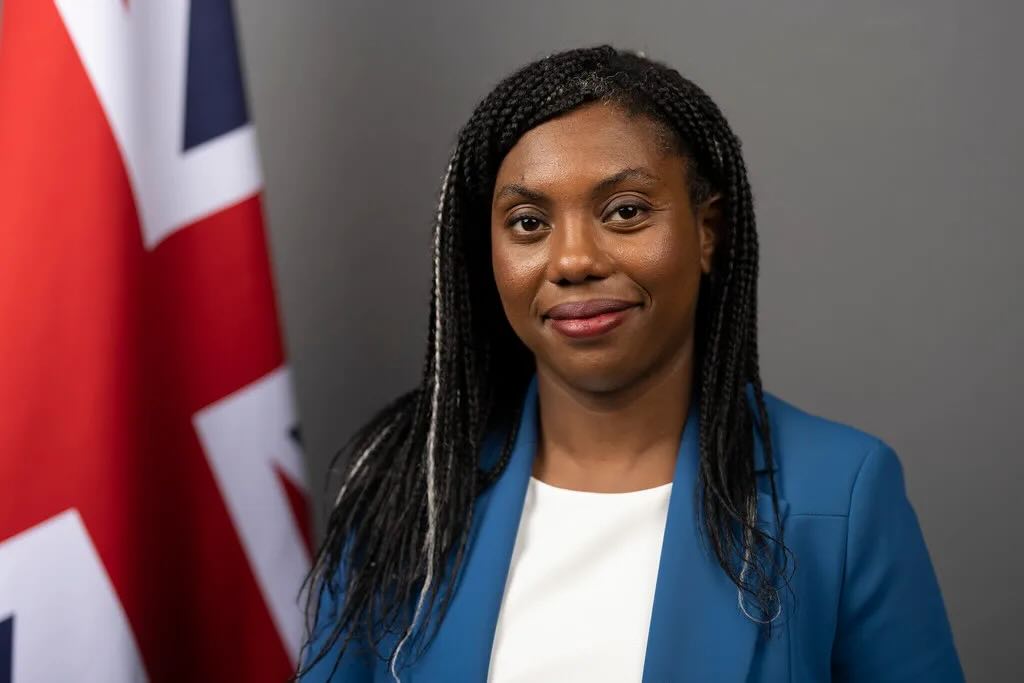
Conservative leader Kemi Badenoch has urged Prime Minister Andy Burnham to bring in emergency legislation to stop the early release of hundreds of prisoners, telling a press conference alongside survivors of sexual abuse that “it’s quite clear that the prime minister sees that this is a problem, but I don’t think he knows what to do about it.”
After huge public pressure, Burnham paused the early release scheme last week after a backlash from victims and their families.
So far, Burnham has announced only a pause and review. He has not revoked the commencement order that brings the scheme into force, nor introduced any legislation, which is what Badenoch is now demanding. Downing Street has not said whether it intends to do either. Unless the government acts, the current legal position remains that the scheme is due to take effect on 2 September.
The programme, which forms part of the Sentencing Act 2026, would have seen around 700 prisoners freed in its first phase in September, with thousands more eligible over the following months as the government sought to relieve severe overcrowding across prisons in England and Wales.
Speaking on Tuesday, Burnham said:
“It is a challenging situation and we shouldn’t actually be in this position as a country, but we have to deal with the reality of where we are.”
He added that he was “looking again” at the policy and had put the September release plan on hold, with further statements to follow “in due course.”
‘Revoke the commencement order’
Addressing reporters flanked by six women who said they or their children could be affected by the release of their abusers, Badenoch said the government’s pause “hasn’t really been paused” and amounted to nothing more than “warm words” unless ministers took concrete action. She called on Burnham to immediately revoke the commencement order underpinning the scheme and to introduce emergency legislation before 2 September, when MPs return from summer recess and the releases are due to begin.
“If Andy Burnham wants to prove that he is serious about this, he needs to revoke the commencement order. That is a simple action that I’m asking for today,” she said.
Shadow victims minister Kieran Mullen, who also spoke at the press conference, later explained the reasoning behind the two-step demand: revoking the commencement order is an executive act the government could take immediately, without recalling Parliament, and would halt the scheme at once, but it can only be used as a temporary measure. To change the policy permanently, and exempt serious offenders for good, the government would still need to pass primary legislation. Badenoch pointed to the government’s willingness to fast-track legislation for a bank holiday had England won the World Cup as evidence such speed was possible, and offered Conservative support to get a bill through Parliament before 2 September.
Badenoch said the early release policy applied to a category of offender, those convicted of serious sexual and violent crimes, that had never previously qualified for early release under any government, including her own.
“We had early release, but not like this,” she said. “We never had this category of prisoners being released. We never had killers, rapists, paedophiles on early release.”
Victims’ testimony
Six women who said they were victims of rape or child sexual abuse spoke at the event. One woman, Carol, read a statement describing how her father was jailed for 20 years after abusing her for more than two years from birth, and said early release meant he would now serve roughly a third of that sentence rather than half.
“It is outrageous that the government are minimising the early release by saying it is only a small amount of time off the sentence,” she said. “No risk review or risk assessment is going to keep me safe from my dad.”
Another woman, Sarah, said she had waited 11 years and endured three criminal trials to secure convictions against two of her abusers, who were sentenced to 19 and 20 years respectively, only to learn both could be released within five to six years.
“I don’t see the fairness,” she said, adding that she feared the psychological toll on the thousands of other victims affected nationally.
A third woman, Vicki, described receiving a letter informing her that her abuser, convicted 36 years after the offence, might be released at the 33% mark of his sentence, and struggled to finish describing how “extremely distressing” she found the prospect, prompting Badenoch to step in and end that part of the news conference out of concern for the women’s welfare.
Mullen also argued the scheme had been “dishonest” in three respects: it had been billed as an “earned progression model” despite releases being automatic; ministers had said the “most serious offenders” would be excluded, which he said was untrue; and the policy had been presented as a short-term response to prison overcrowding when it was, in his view, a permanent change to sentencing.
Political reaction
The prisons crisis has been a recurring flashpoint in British politics. Early release was first introduced by the Conservative government in 2023 in response to overcrowding, initially allowing prisoners out 18 days early before this was extended to 70 days; more than 10,000 prisoners had been released over ten years early under that scheme by the time Labour took office in July 2024.
Labour, under Sir Keir Starmer, went on to introduce its own early release measures shortly after entering government, citing a prison estate that was close to capacity, before further changes were made under the Sentencing Act 2026. So far over 60,000 prisoners have been released early in just two years.
A Labour spokesperson defended the government’s record, saying:
“It’s this government that is fixing the Tories’ mess,” and pointed to the closure of 23 prisons and the creation of only 482 new jail places under the previous Conservative government, alongside the early release of 10,000 prisoners during its time in office.
Liberal Democrat justice spokesperson Jess Brown-Fuller said “no victim or loved ones should ever be told that their perpetrator is being released earlier than expected,” but argued prisons were “on the brink of collapse,” creating the capacity crisis that necessitated emergency measures. Reform UK’s home affairs spokesperson Zia Yusuf said Labour’s policy was “disastrous”.
Badenoch, when asked whether the prisons crisis was a failure of the last Conservative government, acknowledged the problem had been “a long time coming” and said: “We did something, it wasn’t enough, I’m sorry about that… I can’t fix the past, what I can do is come up with solutions.” She said long-term fixes would require new prisons to be built, including in communities that may resist them, and renewed calls for prisoners to be housed overseas, an idea previously explored by successive UK governments but judged too costly when ministers examined sending inmates to Estonia.
The case of PC Andrew Harper has been central to the row. Two of the three people convicted of killing the Thames Valley Police officer, who was dragged to his death behind a car in Berkshire in 2019, were both sentenced to 13 years and would have become eligible for release under the scheme from June 2027. His widow, Lissie Harper, has called the plans “deplorable.”
Without emergency legislation, Badenoch warned, releases could begin from 2 September, the day after Parliament returns from recess, and she said she was prepared to recall Parliament early if necessary to secure exemptions for the most serious violent and sexual offenders.